TSUNAMI RECOVERY - MANY HELPING HANDS
DEALING WITH THE AFTERMATH OF THE 2004 TSUNAMI WAS CHALLENGING BUT THE AUSTRALIAN DEFENCE FORCE MORE THAN ROSE TO THE OCCASION, WRITES THE COMMANDER OF OPERATION SUMATRA ASSIST, MAJOR GENERAL DAVE CHALMERS
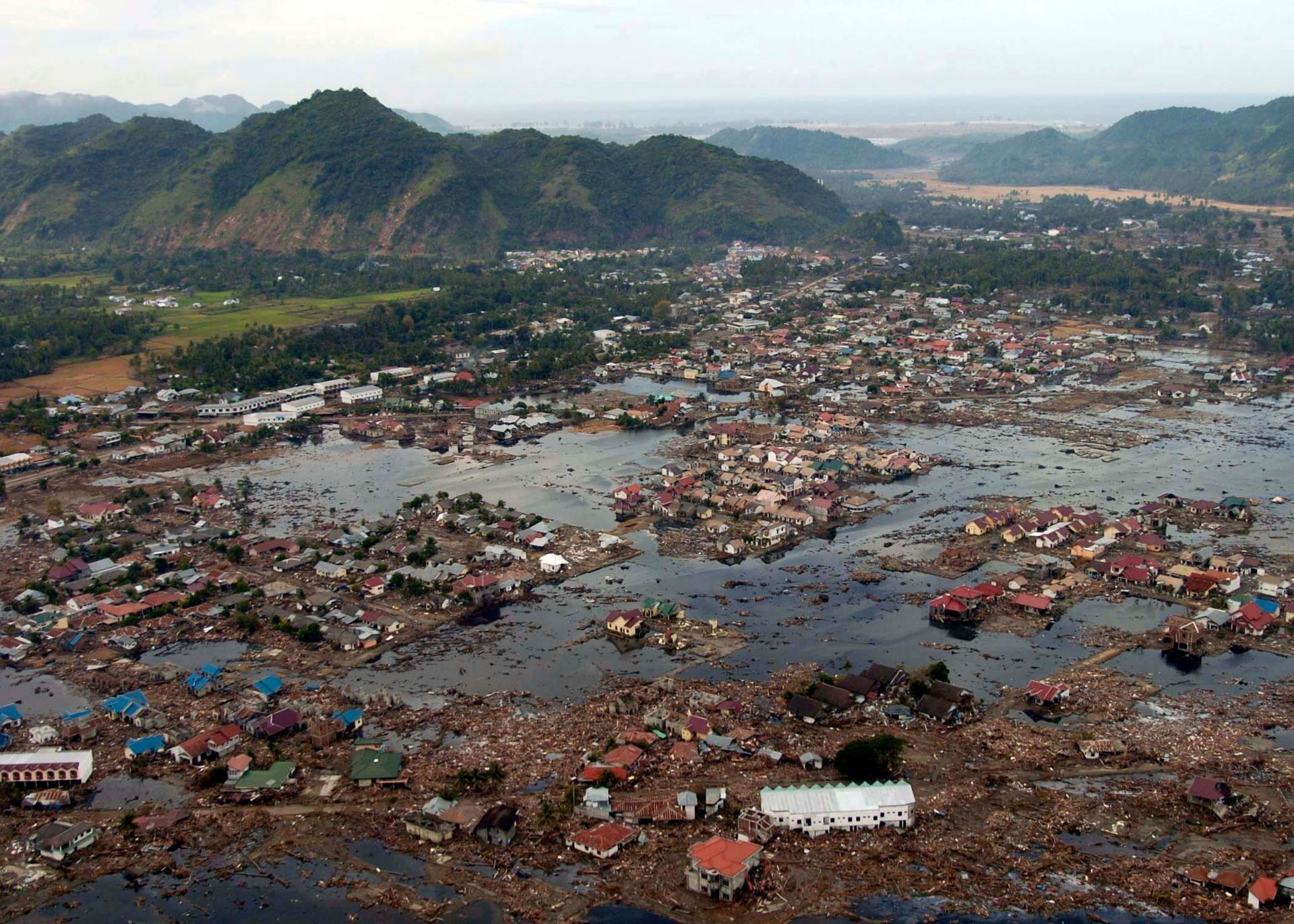
THE BOXING DAY 2004 Indian Ocean tsunami was a disaster of a magnitude that is difficult to comprehend from the relative security of our Australian lounge rooms. At 7.58am on Sunday December 26, an earthquake registering 9.2 on the Richter scale occurred off the west coast of Sumatra, Indonesia. Several buildings collapsed in the provincial capital, Banda Aceh, but the damage was relatively light.
However, a far more powerful force of nature was not far away.
Within 15 minutes of the earthquake, a tsunami, estimated by Indonesian authorities to have peaked at 34 metres, struck the coastline. Like a gigantic scythe, this huge wall of water swept houses, bridges, roads and people away, leaving little but the foundations of coastal villages as it receded. More than a third of the cities of Banda Aceh and Meulaboh were totally destroyed, with thousands of tonnes of wreckage and mud pushed into the areas that escaped the direct effect of the wave.
Some 220,000 people died, many of whom were washed out to sea. But more than 100,000 bodies remained, covered in mud and buried in among the debris left behind in the two cities. Another 500,000 people lost homes - many lost their entire extended family and their business or livelihood as well.
In the first hours after the disaster, survivors provided immediate life-saving aid to each other, with victims acting as rescuers. The resilience of the Acehnese in the hours, days and weeks following the tsunami was quite remarkable, and I wonder if Australians could have coped as stoically in the face of such an event.
Organised assistance was not available. Much of the provincial government infrastructure, both people and facilities, had been lost.
Little local capacity existed to direct relief efforts. At the national level, while the Indonesian Government was unaffected, the ability to gather information and control relief efforts was limited. The Indonesian military were asked to command emergency relief operations in Aceh, but the government quickly recognised that international support was required and called upon neighbours and friends for assistance.
On December 28, an Australian C130 transport aircraft landed in Banda Aceh, the first relief support to arrive. In fact, it landed only just after the Indonesian Commander General Bambang Darmono arrived and before he had had a chance to set up his headquarters or begin any planning. This C130 was the tip of a major Australian Defence Force (ADF) relief operation, which quickly grew to involve a deployed force of some 1,100 Australian, New Zealand and British service personnel. This became Operation Sumatra Assist and the force itself was given the designation, Combined Joint Task Force 629 or CJTF629.
A number of challenges faced the task force as we deployed into Sumatra. The most significant was the initial lack of any substantial information regarding where and how our effort could best be directed. We did know that there were a large number of victims and displaced people, with estimates growing by the hour in the first few days. The paralysis of the Acehnese provincial government made it difficult to find out more. Compounding this, access into Aceh was constrained by the limited capacity of airheads (airstrips that can be used as logistic supply hubs) and the destruction of the ports and west coast roads. Most survivors could be reached only by boat or helicopter.
I also needed to be concerned about the safety of the CJTF, given the environment and security situation in Aceh. The unburied dead and lack of either sanitation or clean water for survivors posed a serious threat to the health of would-be relief workers.
Security constraints also posed a dilemma for an unarmed force - the terrorist threat was high and Aceh's insurgency war continued despite a ceasefire.
A final concern was the so-called "second wave" of the tsunami - the crowd of volunteers, aid organisations and military forces that flooded into Aceh during January and February. Some were invited by the Indonesian Government, but most had just decided to help. Many organisations came without logistic support and some were more of a burden than a boon, particularly those that lacked respect for Indonesian sovereignty.
This complex and daily changing cast of characters overwhelmed the ability of the Indonesian authorities, and the United Nations when they arrived, to synchronise effectively. Adding to the complexity, individual countries independently decided the relief capabilities they could send. Most deployed medical and engineering forces, resulting in too much capacity in some areas and not enough in others. In hindsight, initial assessment support to Indonesia would have been useful, enabling the emergency phase of international aid to be better shaped.
In the absence of much information in the first few hours after the tsunami, Australia's response was based on our experience some years ago in providing assistance after the Papua New Guinea tsunami. Our initial C130 deployment was followed within 48 hours by a small team of medical personnel and Army engineers. The immediacy of this response helped save lives; we had a surgical team working in the Indonesian military hospital in Banda Aceh by December 30. Sadly, while thousands of casualties needed treatment, there were fewer injured than we expected; apparently most of those in the disaster zone had been killed.
The engineers also made a huge impact through the water purification plant they set up in the centre of Banda Aceh. The Convent Water Point, as it was known, provided thousands of litres of safe drinking water during January and February before we handed it over to the Red Cross. It became a visible symbol of the ADF's speed of response and commitment.
Concurrently, the RAAF established a Forward Command Element and our C130s began flying in much-needed medical supplies and food to Aceh. Within a week, a field hospital, six helicopters, engineer reconnaissance teams and the force headquarters were deploying into Medan and then forward to Banda Aceh. The hospital was augmented by a New Zealand medical team, and two of the helicopters were British. We also had a Kiwi C130 flying as part of the combined joint force.
I located my headquarters in Medan, as initially this was the hub for aid distribution and the centre of gravity for decisions. The ANZAC field hospital, a helicopter detachment and an engineer group as well as a forward headquarters were located in Banda Aceh, and a major logistics hub was established in Butterworth, Malaysia. We were also assessing the feasibility of using the port of Sabang, on an island just north of Banda Aceh, as a force extraction point - an option I eventually took up.
Providing the command and control of a combined joint force was a challenge for our small headquarters. This would have been much more difficult had r not had a small but highly effective Civil Military Co-operation capability. These teams were my eyes and ears outside of the headquarters, especially with the hundreds of other agencies seeking our support. Further, they provided a link with the Indonesian Government and military, ensuring that our efforts were always in accordance with the priorities set by the Indonesians. The teams were dispersed across the disaster area providing support to ADF elements where and when required.
Controlled by the Combined Air Operations Centre, our airlift group comprised six C130 transport aircraft, which flew both relief supplies and logistic sustainment for the CJTF from Butterworth and Medan into Banda Aceh, and six Huey UH-1 H helicopters. The helicopters formed part of a fleet of some 75 rotary-wing aircraft, which during January formed the only means of ferrying food and water down to isolated communities on the west coast. The crews lived on the side of the Banda Aceh airfield, in appallingly muddy and noisy conditions, with frequent aftershocks an unpleasant reminder of the cause of the tsunami.
Established by January 6, the ANZAC Field Hospital was located at the Zainal Abidin Hospital in Banda Aceh. The facility comprised an integrated surgical ward with a staff of about 120 Australian and 30 New Zealand personnel. In addition to providing medical support, medics and engineers had to clear the significant amount of mud, debris and damaged hospital equipment that remained in the hospital buildings. Along with the Indonesian infantry soldiers involved in the clean-up, their endurance and motivation was remarkable.
The hospital staff undertook a heavy workload, including treating some horrific injuries and confronting cases. But there were also uplifting moments that helped morale, including the birth of 18 children in the hospital. One of those babies was named Anzac by his grateful parents, a lasting reminder of the hospital's work in Aceh.
Having sailed from Sydney on New Year's eve, HMAS Kanimbla arrived on January 13, and landed our engineer group at Banda Aceh to start work. The Australian Army Engineer Detachment consisted of about 150 troops from the Darwin-based 1st Combat Engineer Regiment. The engineers operated a number of water points throughout Aceh to provide potable water to local communities and to the Banda Aceh Public Hospital.
Another significant task was the removal of debris from the city, and particularly clearing drains to allow floodwater to be dispersed.
This was physically and psychologically demanding work, much of it done by hand, with the frequent discovery of bodies in the wreckage a constant hazard. As a means of providing relief from debris clearing, engineer sections were also asked to recover some of the fishing boats washed into the city, eventually graduating from fairly small craft to re-launching a large fishing boat.
The emergency phase was over by the end of February, and with it the requirement for military support to disaster relief work in Banda Aceh. We worked closely with AusAID to ensure that there was no disruption to the support being provided to the people of Aceh during the transition from military to civilian aid.
It then took four weeks of solid labour to clean our equipment to Australian Quarantine and Inspection Service (AQIS) standards – a costly exercise. Our relationship with AOIS inspectors was good, although they were zealous in the performance of their duties. My extraction plan was to get out of the way of ongoing disaster relief and reconstruction work while we went through this process, and we moved the force to Sabang to do our clean-up. Even so, remaining in the area of operations to clean equipment was a risk, one that may not be acceptable on future operations.
At short notice, while most were on Christmas holidays, more than 1,000 members of the ADF responded to the challenges of the operation and did so professionally. They set the benchmark for behaviour and work ethic, comparing favourably with other foreign military forces. Many more ADF members, although not deployed, worked tirelessly in support of the operation.
Leadership at every level, but particularly by junior non-commissioned officers, was impressive. Much work was done in an environment well outside the normal experience of CJTF members, largely due to the corpses contained in the debris of Banda Aceh.
Small teams, usually led by private soldiers or corporals, did all that was asked of them and more, and set the tone and foundation for the CJTF's success. I was indeed fortunate and very proud to command such a professional force elf soldiers, sailors and airmen.
Major General Dave Chalmers led the Australian Defence Force's Operation Sumatra Assist. He is head of the ADF's Information Capability Management Division.
More design inspirations