Interview with Brendan Moon
INTERVIEW WITH BRENDAN MOON, CO-ORDINATOR GENERAL, NEMA, A CONVERSATION WITH JOHN KEENEY, EDITOR-IN-CHIEF 1MG.
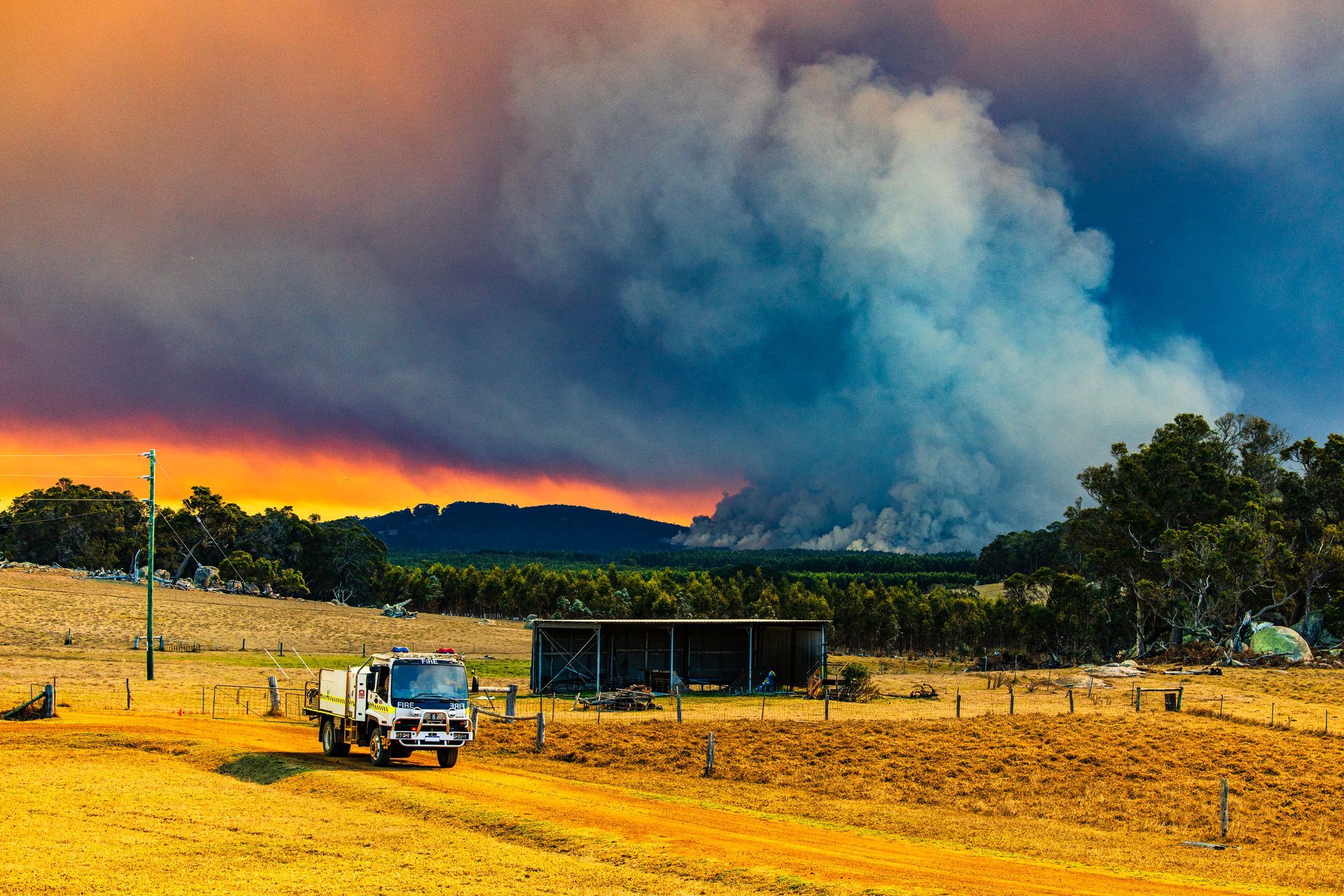
NEMA, as an acronym doesn’t mean much to most people – until its actions save their lives. Or people they know. Or assists in rebuilding their community following a large scale disaster. Then, the National Emergency Management Authority and its actions become vividly real—vital, immediate, urgent.
Many of us who don’t follow government policy in detail, have missed an inspiring story and one which-- when viewed up close--- produces
a genuine thrill, and a surge of national pride.
No kidding. (Personal disclosure: I am hard to impress, get bored easily and maintain as a writer a mostly sceptical or critical outlook).
This Australian story began following WWII, early 50’s – a unit within the Department of Defence became responsible for disaster response,
a flow on from civil defence during the War.
A crucial event arose, under their watch: the “Black Tuesday “fires in Hobart.
Early on Feb 7, 1967 the already hot day was moving to nearly 40 degrees. A benign, below normal wind, 10-15kms per hour at 6 am, rose steadily, then violently due to an incoming cold front, to gusts exceeding 110kms an hour. Within five hours this deadly combination of temperature and windspeed created 110 separate fire fronts which burnt through 2,600 square kilometres. This was no longer a mere fire or bushfire; it was a firestorm.
Within 5 hours:
Sixty-four dead… 80 bridges, 1,500 motor vehicles, 62,000 farm animals, 432 houses in the Metro area, 7,500 buildings in total ... destroyed.
This was an early seminal event which gave witness to a mostly effective combination of military and civilian, local and national parties
working, and fighting desperately, but with determination, together.
Army personnel were mobilized. They played a key role alongside valiant locals during and long after the firestorm was contained, providing community support and aiding re-building. And: from Hobart’s Black Tuesday, lessons were learned –this was probably the real beginning of a conscientious effort to gather data to aid future planning in disaster response and management.
Then, just a few years later, the world of Australian disaster response changed – and swiftly evolved – forever.
Nineteen seventy-three and 1974 were devastating, tragic years for disasters in Australia. Queensland suffered a double whammy: major
floods, then Cyclone Wanda. The federal government presciently - it seems now - created the National Disaster Organization.
On Christmas morning 1974, Cyclone Tracey, a category 4 Cyclone, with several unique characteristics arrived, a direct hit on Darwin, flattening the entire city. This prompted the largest scale evacuation – 30,000 people – in Australia’s history. Over 90% of all buildings
were destroyed, 40,000 were made homeless.
In effect, the small city no longer existed. The death toll at 66 seems merciful, within disaster contexts ………but the physical destruction
was boundless.
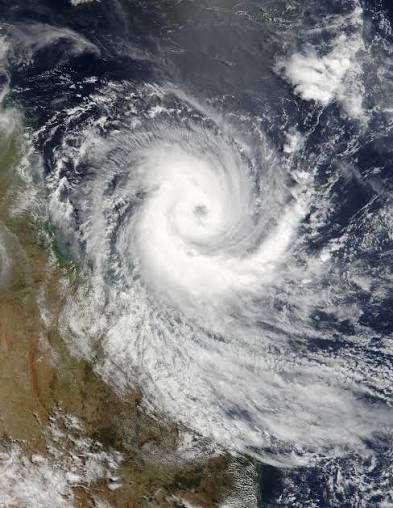
Unique characteristics? Cyclone Tracey was for 34 years the world record holder for having the smallest eye or centre, thus she held an extraordinarily concentrated destructive power. Tracey also hit Darwin directly, unlike most cyclonic events which are more widely spread.
The anemometer at Darwin airport was destroyed with a final reading of 217km per hour, though scientific evidence puts top wind speeds at up to 250 kph. At this point rating a Cyclone like Tracey at 4 or the maximum of 5 becomes academic.
Why? The rating system recognizes top wind speeds as the primary criterion along with diameter. It does not account for the actual movement speed of the cyclone’s eye itself, which in Tracey’s case was slow, sustained, hence more destructive over a longer period. In any case, it is difficult to imagine a more destructive event than that which Darwin and its citizens suffered
on a Christmas morning long ago. This was Nature at its most ferociously savage.
The then newly formed NDO, whose operational mandate was an increase in co-ordination – a very important word in disaster response today – performed very well by any reasonable criteria. The Director General was Major General Alan Stretton, and he emerges, quietly, as an able, perhaps even heroic figure.
Not only did he swiftly organise operational committees in charge of distinct responsibilities – water, food, communications, health – a brief investigation reveals that he resisted declaring martial law, under some pressure to do so, from within the military. This would have been the first and only such declaration since Federation. Instead he urged a state of emergency.
Significantly, Darwin’s traumatic experience galvanized the now standard procedure of Federal-State – Local co-ordination which
continues to progress and enlarge.
In 1992 the NDO became Emergency Management Australia (EMA). This was much more than a simple name change. It was part of a much-considered, multi-faceted move to accomplish several things; it was a notable further progression in the thought and action behind national Disaster response.
One objective was to make it a civil organisation, rather than military, hence a move under the aegis of the Attorney General’s office.
Its role was to become more comprehensive, pro-active and international, including a deeper liaison with the UN.
Its commitment to effective co-ordination with State and Local bodies increased and was honed through disasters in more recent memory : The 2009 “ Black Tuesday “Melbourne Bushfires , where the CBD , this writer recalls, hung with thick smoke down to the ground for many days , and busy colleagues took off work to assist on site , 50 kms away ; and during the horrifyingly persistent “Black Summer “ bushfires of 2019-2020 wherein over 1 billion mammals died , a fact which created global headlines.
The human death toll of Black Summer was mitigated through tactical work and co-ordination by the authorities- national and local both-- who also demonstrated great valour: of the thirty-three dead, nine, or over 25% of these were firefighters.
In its current, further advanced state EMA has become NEMA, as of 2022, another considered, deliberate evolution. NEMA became a merged entity incorporating the National Recovery and Resilience Authority within the Department of Home Affairs, under Brendan Moon, whose title, indicatively, is Co-ordinator General.
In the following interview I am pleased to speak with Mr. Moon about his background, NEMA itself and contemporary perspectives as to Disaster response, management and recovery.
He is a tall and a remarkably youthful 67, perhaps owing to a distinguished previous career as an internationally renowned Rugby Union winger with the Wallabies,1978-1986. He was inducted into the Queensland Hall of Sport Fame in 2025 and honoured as a Member of the Order of Australia (AM) for his contributions to both public service and to sport.
He speaks with precision and is amiable and engaging, but quick to draw the line when an edge of propriety appears. When asked about Trump’s move to dissolve FEMA he pleasantly responds, “As a public servant, I prefer not to comment on politicians.”
JK: Brendan, I am interested, having had a sustained editorial involvement with EMA some twenty years ago, in the rise of Reconstruction Authorities, which did not exist back then, and which I see form a significant part of your experience prior to leading NEMA.
BM: To understand the concept of a reconstruction authority, it’s useful to look first at Queensland, with its widely dispersed population – many regional centres. This fact, coupled with the aftermath of severe flooding and Cyclone Yasi, 2010-2011, caused then Premier Anna Bligh to create a discrete agency based on post disaster recovery, and this was the genesis of the reconstruction agencies as stand-alone bodies. It was fitting that it started in Queensland as it is the most disaster-prone state due to climate, beyond the settlement patterns I mentioned.
JK: There was something conceptually new about its role?
BM: Yes, up until that time recovery was not a commonly used word or idea in disaster management. But the Queensland events made clear that the aftermath was likely where the biggest, or most sustained actions were needed, or a number of different, complementary skill sets, had to be applied.
JK: This is probably where another big and comparatively recent word in the sector comes in, co-ordination.
BM: Yes, exactly, there was a need to co-ordi-nate in Queensland’s flood and cyclone aftermath, both at a local government level and the State. For the first time ever, there was a plan established by local government with State involvement, coordinated by the State government, co-funded with Commonwealth government JK: And how comprehensive were these plans?
BM: Much broader than ever before, and importantly, not just about infrastructure, but about human and cultural factors, the environment and the economy. There was community consultation. This reconstruction effort was probably the first ever to bring in environmental concerns for the re-build, for the future.
JK: This was actually something of a revolution or a whole new paradigm as to looking at disaster management.
BM: It was, very much so.
JK: And it led to a similar body being created in NSW and …
BM: Yes, in NSW with a similar titling, and in Victoria, Emergency Recovery Victoria, works with Emergency Management Victoria covering very similar ground as to reconstruction.
JK: And the other States without such a facility?
BM: I should say first, taking the example of WA, say, that they have great capability if in different forms- in different agencies. There is no one size fits all solution for Australia. Each state is different. WA has a vastly different population settlement pattern for example. In my experience, what drives the creation of a reconstruction agency is a big event which impacts a major population centre, as in the Queensland experience. In NSW the big event was the massive flooding in 2022. A catastrophic
event, with serious economic consequences will typically galvanize government, financiers, the private sector to create this kind of entity.
JK: Another new word or phrase which seems to have entered the specialist vocabulary since my encounter with EMA is the idea of “scaling up” resources.
BM: Yes, and this is a product, mainly of larger magnitude disasters which involve more than one jurisdictional area, like the 2019-2020 bushfires. It requires another type of co-ordination and readiness.
JK: Are you suggesting that the scale of disasters in Australia are becoming larger in magnitude, more often or more generally?
BM: That has been our experience, our changing climate driving natural hazards are becoming more frequent and more complex.
JK: Well, you don’t need to be a scientist, merely a skier to discern a serious decline of snow, and the ancillary effects of climate change…… We’ve been tearfully looking for snow quality of the past for at least two decades.
BM: Yes, true…… and the corollary to your experience…. in the history of Australian disaster or emergency management is one where previously, we had more discrete, smaller events, serious, but smaller. The magnitude of more recent times has clearly shaped how we think and plan now.
JK: Another new word –to me—in your arena is “resilience “…..I must have read it a dozen times in the past week or so, in prep for this discussion, Brendan. Can you speak about this please?
BM: The definition we use of resilience is the ability of a system to absorb, react, respond, and recover from an extreme event.
JK: This represents a great enlargement of philosophy in your sector, it seems to me, compared with the past.BM: Roughly I think the evolution time frame of as you say, philosophy, is that in the 90’s and early this century, the focus was on “managing an incident”. What followed this was a consideration over some years as to “consequences.”
From about 2010 onwards the thinking evolved toward “risk reduction and resilience”. And I think one of the spurs for this was our involvement with the United Nations.
JK: You are involved with the UN?
BM: Yes and rather steadily. But the point I make here is that the Sendai agreement, adopted by many countries in 2015 uplifted,
you might say solidified, a number of protocols, and no doubt it had impact on our thinking.
This was all organized by the UN, of course in consultation with agencies worldwide, and their governments. It’s a framework, a way of approaching the broader topic.
JK: Can you give me a practical example arising from the Sendai agreement that has actually informed your work methods?
BM: Using data and historical knowledge to better deal with known unknowns, you might say – which is what we do… this being a part of building resilience. And a framing of agreed upon objectives.
We have focused much more effort on understanding risk, mitigating the effects of natural hazards and ensuring we have the right systems in place to manage all hazards.
JK: Up to this point we have been speaking a good deal about theory and philosophy.
I should say that whilst I am a believer in the UN mission and in it as an idea and an organisation, from considerable time spent in Africa, the criticism that it is often too theoretical and falls down in practical application appears justified at least to some extent.
BM: That may be true in some cases. I would need more particulars to make any kind of informed comment. In this instance, for perspective consider the value of a multi-day conference which offers a very considered framework which is deeply informative. I would not say it is the be all and end all of the work we need to do, but valuable in its place. It was also a milestone in the evolution I have been describing. It was elevated sharing, another key word.
JK: In truth, it is less a remark about the UN and the Sendai framework –which seems to be perfectly sound theory as far as I can judge from reading it -………and more a query about the actual performance of NEMA , in the eyes both of the public it has directly served , -and within bounds of fairness- government oversight and the inevitable reviews , some unfavourable.
It’s about delving into the dichotomy between elegant theory and actual functionality when the rubber hits the road.
BM: From my personal experience there are highs and lows. One of the lows in the early period was being responsible for $6 Billion in recovery spending and having people tell me “We still do not feel safe.” And: “How are you making my life safer?”
JK: Yes, difficult. Having read the Colvin and Glasser reviews of NEMA, I can see that whereas there are some criticisms to do with funding delays, red tape, over reliance on the ADF and even some corruption allegations, that overall the score card is generally positive. Would you care to comment on any specific criticisms in either of these reviews? I have my own considered opinion which I will withhold for the moment.
BM: We have committed these past years in reducing red tape, ensuring support is mobilised quickly it is targeted to the most vulnerable, but also allows communities to invest more in resilience.
JK: (possible response to above, and move onto another question/concluding point, which is:) Two things occur to me which are fundamental to this discussion. The first is, given the long history of learning and very definite performance, there can be no rational alternative to a national Co-ordinator such as NEMA; there are too many positive case studies and attributes, capabilities
to point to. The runs are on the board.
The second point arises directly from the first: what are the areas you believe must evolve most quickly? The Colvin review* determined that Australia’s “disaster management frameworks have not kept pace with the accelerating nature of disasters.” To say this less diplomatically: “NEMA has not evolved quickly enough.” That was issued almost two years ago, and their data obviously preceded that date. So…….. *[The Colvin review was a Fed Govt investigation to ensure government disaster expenditure was appropriate given increase in major events headed by Andrew Colvin,of Deloitte’s, also former Commissioner AFP, issued April 30 2024]
BM: We must remain firmly invested in building national capabilities that are scalable, mobile and able to co-ordinate response and recovery no matter where, when nor the hazard.
Similarly ensuring all we do builds resilient systems.
Systems be they community, economic, environmental, technological that can withstand any of the challenges our complex risk
environment poses.
JK: I will give my considered opinion, if I may. Having read scores of government reports, reviews, green and white papers, et cetera, over the years and recognizing that Australia is a well governed country in the main -certainly on a comparative basis – the Glasser and Colvin reviews are basically constructive, and actually unsurprising, especially for a fairly new organisation.
If one were to compare –microscopically, as these things are done – any very large private sector corporation, or in fact a newly merged federal government department -for example, one would find no doubt a similar, if not identical quantity of perceived shortcomings, possibly more.
Except for one thing: very few private sector companies or government departments deal with quite as much sheer complexity and uncertainty, -and urgency- as NEMA. This is not to say that the issues raised are trivial, some are fundamental.
I’d like to move on please to a subject which, based on some personal experience is rather special, gladdening. That is the generally long tenure of people in the Emergency and Disaster management sphere, and their devotion, and ask if in your view Australia stands out, or if I am wearing rose tinted glasses here?
BM: I’ve spent a lot of time overseas, been on front lines, and I would agree ……..there is something remarkable about the Australian Emergency management sector in terms of individual’s sense of mission and accomplishment, of attitude. There are many people who have been in this sector for a very long time.
Their commitment is deep.
But it is also important to look at the great diversity of the sector which as it evolves – we have many more partners now than previously – which is a necessity as Climate Change itself is rapidly evolving …. that the different sorts of people involved are more varied. They range from career specialists who are deeply attached to their roles, volunteers, local government, the ADF, the NFP sector, the private sector. And younger people are now entering as volunteers, and to engage ideally with them, we must evolve
for them, to earn their commitment.
JK: Twenty years ago one heard, proudly, now and then, and I think credibly enough, that emergency management in Australia was regarded as one of the best, in some areas perhaps the best in the world. Do you share that view?
BM: We don’t look at it in that way. Of course, we have some highly capable, superior local and regional services and authorities. But we have more a global outlook, an attitude of sharing. It’s not about comparisons as such. I not long ago came off of an event wherein we had 4-5,000 people made homeless. I shortly after hosted a team from Nepal who had been grappling with 700,000 victims of an earthquake, a figure so high I could hardly even comprehend it. People who had taken a year off work to deal with the consequences. This was humbling. That was a profound sharing experience.
JK: Yes, I take your point. It’s a reflection of having become more global and in a world which in many senses is becoming more integrated. I’d like to ask, based on some acquaintances of mine and a little research, about growth in the private sector side of Emergency management over the past 20 years or so. I am certain there has been a good deal of it but have found no figures. I am thinking about SMEs like Helimods which have grown enormously in recent years, and Aspen Medical, now a giant in its
field, amongst a fair few other.
BM: I’m afraid I do not have figures on this either. But the growth in the private sector side of our work has indisputably grown. And as said earlier we have many more active participants, and more diversely talented partners than in the past. And these would range from construction companies who have created rapid response building units, to supermarket chains who can assist in supply chain breakages, deliveries and transport. The logistics sector is of course skilled and vital to these missions. Following a disaster services like finance come into play.
JK: I’ve read briefly about the National Co-ordination Mechanism, can you elaborate, as I gather it is run by NEMA?
BM: Yes, and this underlines the link we’ve been talking about with the Private Sector, and their co-ordination of it with local, state and federal government and the various other sectors we’ve discussed. Pardon the name, I realize it sounds a little odd to those not familiar …….. we just call it the NCM, but that and another acronym, which I will give you in a moment , I think will be quite interesting for your readers—in terms of what government does to organize in total a total response system for disasters.
JK: It is basically a regular forum for discussion, right?
BM: Yes. The NCM is a comprehensive national crisis coordination process. The NCM facilitates a sector based, integrated and coherent planning process. It defines problems, reveals escalation triggers, identifies and agrees courses of action and responsibilities. Importantly it establishes oversight and communication arrangements.
JK: So it could be called a regular forum to look at and solve potential problems, look at scenarios, new circumstances which arise from a disaster?
BM: That’s a fair summary. It exists to anticipate problems, and the other key function, or capability, going back to a word we discussed in another context, its scalable, meaning that in the event of a disaster, it can intensify co-ordinated collaboration, action and response.
JK: You had another acronym for me?
BM: Yes , and I think it’s useful for your audience to know that such a program exists, being, sorry for another acronym here, but AGCMF -- Australian Government Crisis Management Framework, this is the overarching structure at the highest level, and not just theoretical, but a functioning system , and series of protocols, managed by the Office of Prime Minister and Cabinet. In a major emergency the PM would become directly involved.
JK: And this was created, I believe, in 2010? And I note that The National Emergency Stockpile, which seems to not have an acronym (joint laughter) – though it is serious business – was established as recently as 2023, and is supervised
by NEMA?
BM: Yes 2010, for AGCMF, but the main feature to underline, is, as we have used the word evolve frequently in this conversation, is that it is under continual review. The National Emergency Stockpile is a further case of active collaboration between government and the private sector. At various sites around the country there are provisions for an emergency, a major disaster ...
JK: What sort of provisions?
BM: Many things, and a growing list. Hi-tech rapidly deployable shelters, generators for power, food, and catering services for food designed for a catastrophic incident, rapid delivery.
Things also like sandbags and equipment for dealing with floods.
JK: And Medicines, medical equipment?
BM: That is handled by a close cousin organisation which has been around longer, since 2002 which is called the National Medical
Stockpile, under the Department of Health, Disability, and Ageing.
JK: I have to say Bendan you look remarkably calm, given what I now understand to be the thoughts and eventualities which ……. inform, … or drive ……. your work life.
BM: I think all of us in our sector are preoccupied with the notion of what to do when events become bigger than we are ……….and that calm rationality and planning are the only antidotes.
JK: Very quotable, “When events become bigger than we are.” Let’s hope not. May I ask if you have any summary remarks here,
as we are now in overtime and you have a busy day ahead ……..
BM: We have been speaking about climate related weather events. But I think your audience ought to know that our work, our duty is to prepare for any kind of hazard, whether climate related, cyber -security, space weather, earthquakes, supply chain disruptions, geo-political situations. These events are becoming more complex, and they are likely to coalesce, so we know our capabilities will
be stretched, that’s a given. And the only solution are the words we’ve used often here, evolve and increase resilience.
JK: And continue to perfect co-ordination, which is now abundantly clearer to me in practice.
BM: Yes, Co-ordination, perhaps a bland word but full of meaning and practicality here.
JK: This has been actually revelatory Brendan, thank you. I am realizing in full –and I expected some growth and expansion over 20 years, but not to this degree – the extent of evolution in the Emergency and Disaster sector, in Government planning. It’s a massive and significantly under told story, in my opinion as an Editor.
More design inspirations